
BLOGS
How Schools Can Prepare Children for the AI-Driven Future
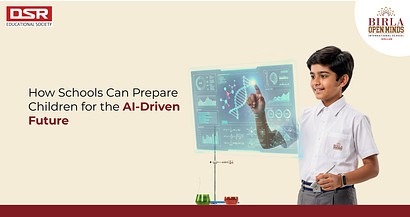
An individual born this year and starting kindergarten will enter a workforce where technologies that were nonexistent at the start of his or her parents’ careers now dominate. This is not some remote scenario. We see AI redefining entry-level jobs in every industry by taking over processes which have been used as building blocks of early career experience, and there does not seem to be any end to this trend in sight. It is not a matter of whether we can help our schools respond to the changes, but of how schools can prepare children for an AI-driven future.
Why This Requires More Than a New Subject
It is easy to think of AI preparedness as a problem in how the curriculum should be supplemented, add a course on machine learning, perhaps an elective on robotics, and think that this takes care of everything. This fails to understand just how much needs to be done. AI is more than a new technology to master; it is an agent that alters the landscape of what skills humans need, versus what skills become obsolete. To prepare our kids for this world means fundamentally reconsidering how schools spend their energy and resources.
Those things which AI struggles to imitate – imagination, ethical thinking, emotional intelligence, and handling situations of ambiguity and novelty – are those things which traditional, knowledge-based schools have tended to de-emphasise at the expense of rote memorisation. Addressing this imbalance necessitates a restructuring of a school’s approach to learning rather than the addition of an extra module to its curriculum.
The Skills Students Actually Need in the Age of AI
Identifying the skills students need in the age of AI means distinguishing between two types of skills that are regularly confused with each other. The first skill refers to being technically literate, which means having some understanding of how AI works, what its strengths and weaknesses are, and the ethical issues that arise from the application of these technologies. While it does not necessarily mean that the students should develop into machine learning engineers, they certainly need enough literacy and experience in areas such as data science, robotics, etc.
The other, and even more important, type of skills is human capabilities. Skills that allow you to come up with completely new ideas instead of putting old pieces together in a new way. Critical skills, which would allow you to evaluate output provided by artificial intelligence instead of accepting it blindly. Emotional intelligence and people skills, because the professions that will not be easily replaced by automation are precisely the ones that require human interaction. Flexibility, because the particular tools and platforms that students learn now will probably become obsolete or changed when they get into the workforce, making the capacity to learn new systems quickly more valuable than mastery of any single current tool.
Why AI Education in Schools Has Become Genuinely Urgent
The importance of AI education in schools is no longer a matter for the future that belongs only to specialised institutions. The jobs of entry-level in law, in finance, in customer services, in content creation, and even in certain technical professions are already being transformed by the ability to use AI, and the children currently in schools will be competing in the workforce where such transformations have moved much farther. The school which takes AI to be somebody else’s business to deal with in the university or first job is setting its graduates up to compete behind schedule.
This urgency does not mean panic or wholesale curriculum overhaul overnight. It means a deliberate, structured introduction to AI concepts, beginning early and increasing in depth and complexity as students mature, paired with an equally deliberate investment in the human capabilities that will differentiate students once they enter a workforce where basic technical AI literacy is simply assumed of everyone.
Building Future-Ready Skills Without Sacrificing Foundational Learning
A reasonable concern among parents and educators alike is whether future-ready skills for school students can be developed without crowding out the foundational academic learning, literacy, numeracy, scientific reasoning, that remains genuinely essential regardless of how AI reshapes the world. The strongest approach treats these as complementary rather than competing priorities.
Learning, which is interdisciplinary and project-oriented, integrates all the mentioned capacities in an effective way. For instance, when a student is engaged in researching and evaluating a real-life problem, presenting the results of his research to fellow students, he gains a lot in terms of critical thinking, communication, and teamwork skills, as well as consolidates the knowledge in whatever discipline he works within. Working with complex material and unfamiliar areas, such as neuroscience or behavioural analysis, helps a student to feel more comfortable about challenging and new things, which cannot be done by traditional education focused on a single subject.
Mentorship becomes especially critical in this case because the type of judgment, ethics, and self-awareness involved in such an ability set can only be developed effectively through reflective mentoring by an adult rather than by any other passive mode of teaching or through worksheet assignments.
Preparing Children for Careers That Do Not Yet Exist
Preparing children for careers in the AI era carries a particular kind of uncertainty that previous generations of educators did not have to fully grapple with: many of the specific jobs today's students will eventually hold have not been invented yet. This makes it considerably less useful to prepare students for a fixed set of known careers and considerably more important to prepare them with the underlying capacity to learn, adapt, and apply judgment across whatever
This is precisely why character development, emotional resilience, and ethical reasoning deserve a place in the curriculum alongside technical exposure to AI and computing. A student who has practised navigating ambiguity, recovering from setbacks, and reasoning through ethical complexity carries a transferable foundation that no single technical skill, however current today, can guarantee on its own. The specific tools will change. The capacity to think clearly, act with integrity, and adapt under uncertainty will not go out of date.
At Birla Open Minds, we have built our approach to this challenge around exactly this understanding, that preparing children for an AI-driven future requires developing the whole child rather than simply adding technical content to an existing structure.
Our curriculum integrates STEM-based learning and digital literacy as a genuine priority across our K12 programme, while our Soul Science curriculum ensures that emotional and ethical development receive equal structural seriousness, recognising that the human qualities AI cannot replicate, compassion, self-awareness, and conscious decision-making, are exactly what our Soul Science framework is designed to cultivate. Across our network of over 280 institutions, we have committed to fostering the spirit of internationalism and interdisciplinary thinking that genuine adaptability requires, alongside Career Development Programmes that help students explore pathways still taking shape rather than ones already fixed. We believe a future-ready education has to prepare students for uncertainty itself, not just for the specific technologies visible today.
Conclusion
The future where everything is run through artificial intelligence is not something that can be dealt with later in the future by schools. The future where everyone is going to adapt to AI is here right now, and it is the present world that the students are stepping into. Schools that realise that early on and create an educational structure that is capable of teaching students the skills needed for the future, as well as skills unique to humans, will be the ones that graduate students who are ready for the future and not those who were taken by surprise by how fast things have changed.

Experienced and Dedicated Faculty
A school is only as good as its teachers. The top schools in Hyderabad hire qualified, passionate educators who receive continuous professional development training. This ensures that every teacher brings fresh, effective pedagogical methods into the classroom — keeping students engaged and motivated throughout the year.
Focus on Social and Emotional Learning
Academic scores matter, but emotional intelligence is equally important for long-term success. Leading schools incorporate Social and Emotional Learning (SEL) programmes that teach students empathy, resilience, teamwork, and conflict resolution — skills that serve them throughout life.
- Structured counselling sessions and mental wellness programmes
- Peer mentoring and buddy systems for new students
- Group projects that build collaboration and communication
- Annual leadership camps and outbound learning programmes
Industry-Ready Skill Development
To prepare students for Industry 4.0, top schools in Hyderabad integrate coding, robotics, artificial intelligence workshops, and entrepreneurship programmes into the curriculum. Students graduate not just academically prepared, but career-ready with real skills that the modern world demands.
Conclusion
The journey to student success begins with choosing the right educational environment. The Top Schools in Hyderabad go beyond academics to create well-rounded individuals who are confident, curious, and capable. If you are looking for a school that truly invests in your child's future, Birla Open Minds Hyderabad stands as a premier choice for holistic, future-focused education.
← Back to BlogsRelated Blogs


